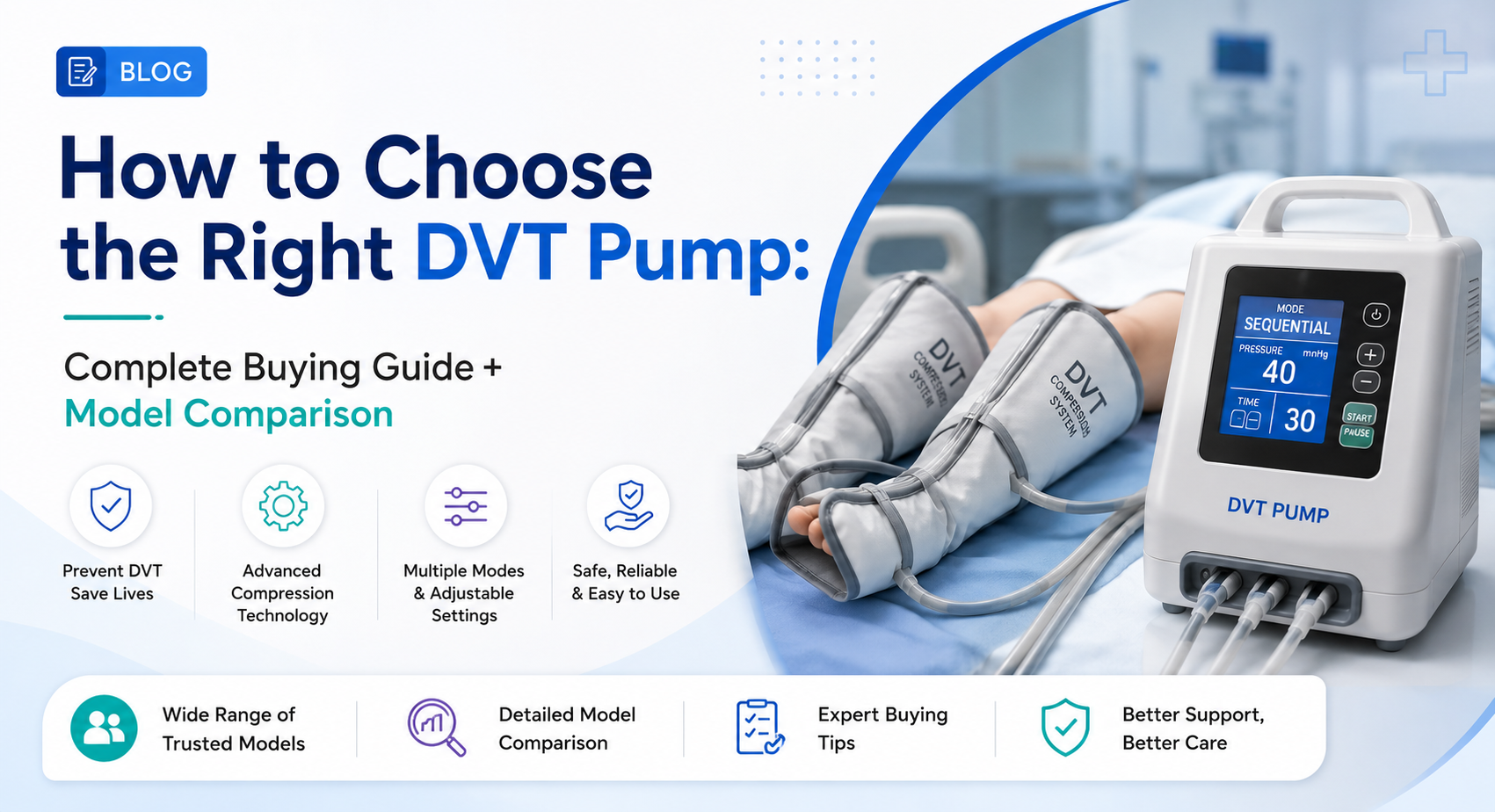
DVT Pump Buying Guide: How to Choose the Right DVT Compression Pump
Buying a DVT pump isn't just about picking the first machine you find, is the right choice depends on where it will be used, who it's treating, and how it fits into your daily workflow. This guide walks you through everything to check before you buy, so you invest in a DVT compression pump that actually matches your clinical needs and budget.
Identify Where You'll Use the DVT Pump
Your setting determines almost everything else on this list.
-
Hospital / ICU: Look for programmable, dual-channel units built for continuous, high-frequency use across multiple patients.
-
Clinic or Nursing Home: A mid-range unit with adjustable pressure and durable sleeves usually covers most needs without ICU-level features.
-
Home Care: Prioritize compact, quiet, easy-to-operate models that a caregiver, not just a trained nurse, can manage confidently.
Decide Between Single-Channel and Dual-Channel
-
Single-Channel: Compresses one leg at a time. Lower cost, suitable for patients needing therapy on one limb only.
-
Dual-Channel: Compresses both legs simultaneously. Preferred in post-surgical and ICU settings, since it cuts therapy time and supports consistent, bilateral circulation. If you're treating multiple patients or running the device frequently, dual-channel pays for itself in time saved.
Check Pressure Settings and Programmability
Every patient's tolerance and clinical requirement is different. A good DVT machine should let you:
-
Adjust compression pressure within a safe clinical range
-
Set inflation/deflation timing to match the prescribed therapy cycle
-
Save or switch between preset programs if treating multiple patients on rotation
Basic units offer fixed or limited settings — fine for standard cases, but restrictive for varied patient needs.
Consider Portability and Power Source
-
Wall-Powered Units: More affordable, ideal for a fixed bedside setup.
-
Battery-Backed Portable Units: Higher upfront cost, but essential if the patient needs to move between departments, or for home use where power backup matters.
If portability isn't a real requirement, a wall-powered unit is often the more cost-effective choice.
Match Sleeve Size and Compatibility
Ill-fitting sleeves reduce both comfort and therapeutic effectiveness. Before buying, confirm:
-
The manufacturer offers multiple sleeve sizes (not just one standard size)
-
Replacement sleeves are easily available — sleeves wear out faster than the pump unit itself
-
Sleeve material is skin-friendly for extended wear, especially for long-term or home-care patients
Evaluate Noise Level and Patient Comfort
A DVT pump often runs for hours at a stretch, sometimes overnight. A noisy motor can disrupt patient rest and, over time, discourage compliance with therapy. Where possible, ask for a demo or check the manufacturer's noise rating before purchase this matters more in home care and general wards than in a busy ICU.
Look for Built-In Safety Features
Non-negotiable features to check:
-
Alarm system for sleeve disconnection or pressure faults
-
Overpressure protection to prevent unsafe compression levels
-
Clear indicator lights or digital alerts so nursing staff can respond quickly without needing to interpret ambiguous signals
Compare Brand Reliability and Build Quality
Cheaper, unbranded units may cut upfront cost but often fail sooner or lack consistent sleeve/part availability later. When comparing brands, check:
-
Track record in Indian hospitals and clinics
-
Availability of spare parts and replacement sleeves
-
Genuine sourcing — buy through authorized sellers to avoid counterfeit or refurbished units sold as new
Set Your Budget Against DVT Pump Price Ranges
Broadly, DVT pump price in India falls into two bands:
-
Basic units: ₹28,000 – ₹38,000 for standard sequential compression needs
-
Advanced units: ₹40,000 – ₹1,30,000 for programmable, multi-patient, ICU-grade
Don't buy purely on price, an underpowered unit for a high-demand ICU setting will cost more in downtime and replacement than paying slightly more upfront for the right fit.
Confirm Warranty and After-Sales Support
Before finalizing:
-
Check warranty duration and what it actually covers (motor, sleeves, electronics)
-
Ask about service turnaround time in case of a fault
-
Confirm whether replacement sleeves and accessories are stocked locally or need to be imported
Quick Buying Checklist
Use this before you finalize any DVT pump purchase:
-
Matched to your setting (hospital, clinic, or home care)
-
Right channel type (single vs dual)
-
Pressure and program settings suit your patient range
-
Power source fits your mobility needs
-
Correct sleeve sizing available, with easy replacements
-
Acceptable noise level for the care setting
-
Safety alarms and overpressure protection included
-
Purchased from an authorized, verified seller
-
Within your budget without compromising on core features
-
Warranty and after-sales support confirmed in writing
Common Mistakes to Avoid When Buying a DVT Pump
-
Choosing solely on price and ending up with a unit that can't handle ICU-level frequency of use.
-
Ignoring sleeve availability — a pump is only as useful as its ready supply of compatible sleeves.
-
Skipping the demo/trial where possible, especially for high-value bulk orders.
-
Buying from unverified sellers to save a few thousand rupees, risking counterfeit units with no real warranty backing.
FAQs: DVT Pump Buying Guide
- What should I check first before buying a DVT pump?
Start with where and how often it will be used — a hospital ICU has very different requirements than a home-care setup, and this decision shapes every other spec you should look for.
- Is a dual-channel DVT pump worth the extra cost?
For hospitals and clinics treating multiple patients or post-surgical cases regularly, yes — it saves therapy time and supports both legs simultaneously. For occasional single-leg use, a single-channel unit is often sufficient.
- How do I know if a DVT pump is from a genuine seller?
Buy only through authorized distributors or verified sellers who can provide manufacturer invoices and honor warranty claims directly — avoid unusually discounted units from unverified sources.
- Do I need a portable DVT pump for home use?
Not always, but a compact, easy-to-operate, and reasonably quiet unit is recommended for home care, since it will typically be managed by a caregiver rather than clinical staff.
- How often do DVT pump sleeves need to be replaced?
Sleeves wear out well before the pump unit itself, especially with daily use — check sleeve durability and replacement cost as part of your total cost of ownership, not just the upfront machine price.